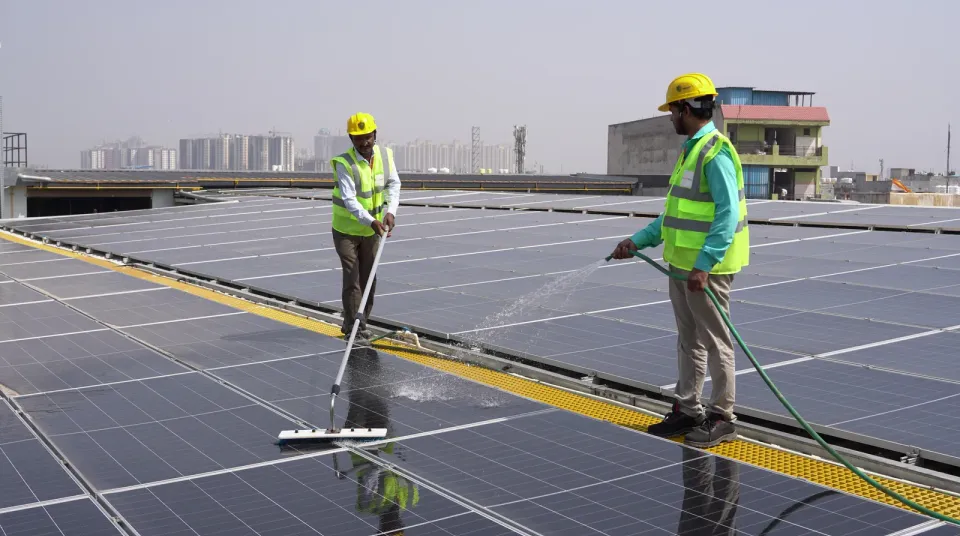
[PLACEHOLDER — replace] Intro paragraph: explain how airborne dust and soiling settle on module surfaces, progressively reducing DC output, and why the timing of cleaning cycles is what actually determines quarterly energy recovery.
How soiling erodes DC yield
[PLACEHOLDER — replace] Describe the dust accumulation curve, how the soiling ratio (%) translates to lost string current, and why fixed calendar-based cleaning underperforms.
Calculating the recovery threshold
[PLACEHOLDER — replace] Walk through the DC recovery calculation — comparing the cost of a cleaning cycle against the recovered kWh value — and show the breakeven point.
Scheduling for maximum ROI
[PLACEHOLDER — replace] Explain how site-specific soiling rates, rainfall, and tariff structure should set the cleaning cadence.
- Measure the local soiling rate — [PLACEHOLDER — replace] Establish a baseline using reference cells or the before/after generation delta.
- Price each cycle against recovered yield — [PLACEHOLDER — replace] Convert recovered DC energy into ₹ at your PPA or tariff rate.
- Trigger on threshold, not calendar — [PLACEHOLDER — replace] Clean only when the soiling loss exceeds the cycle cost.
[PLACEHOLDER — replace] A pull-quote tying cleaning frequency to recovered generation and quarterly returns.